
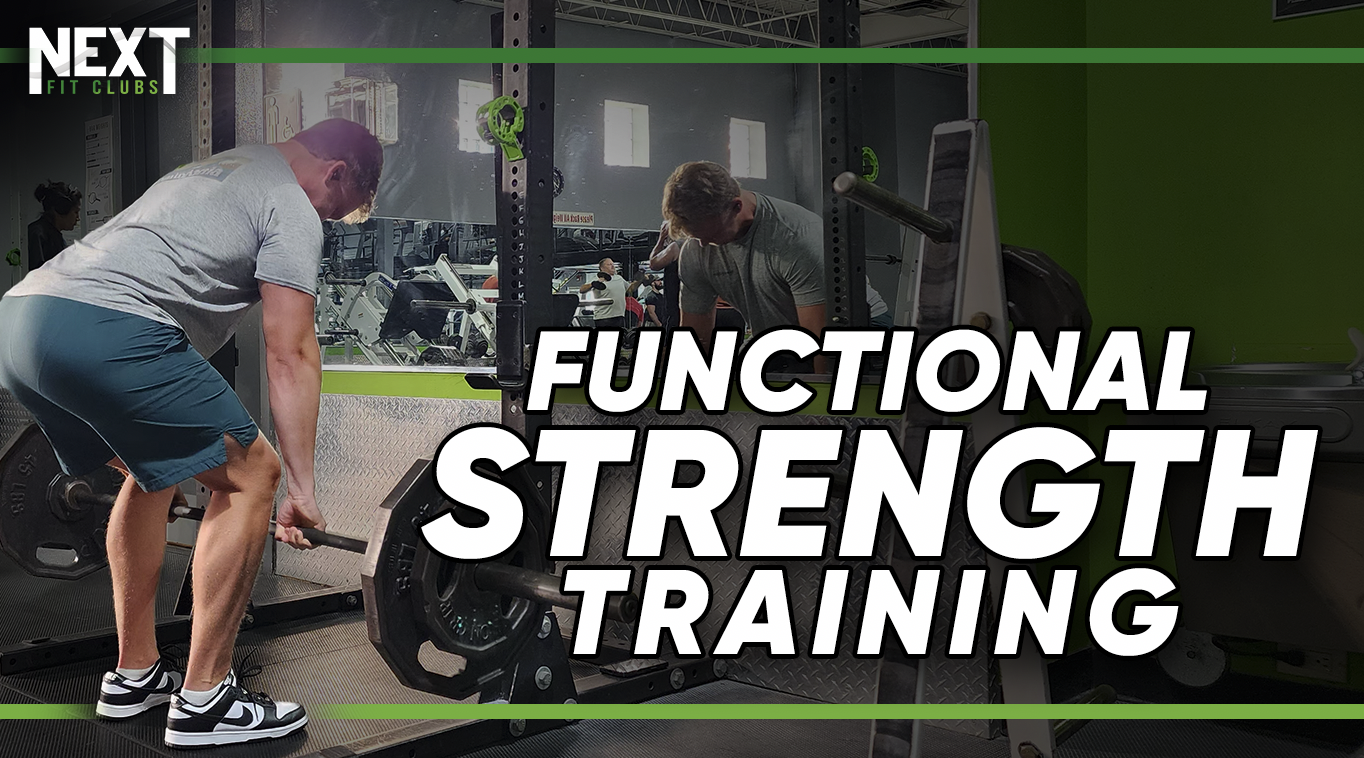

Your Workout Is Building Muscle You Cannot Use: Functional Strength Training in Hillsborough and Princeton
Walk through our gym in Hillsborough on a Tuesday night and you can predict most of it. Leg press. Lat pulldown. Leg extension. Bicep curl. Three sets of ten, phone propped against the weight stack, same order every week since 2019.
None of that is wrong. It built real muscle for a lot of people. But if that is the whole program, something is quietly going missing, and most people do not notice until a Saturday in October when they pick up a bag of mulch and feel something let go in their lower back.
That gap between the muscle you have built and the movement you can actually produce is what functional strength training closes. Here is what that means, why our training staff at NexT Fit Clubs has leaned into it hard this year, and what it would change about your next twelve weeks.
What most training in central New Jersey actually looks like right now
Be honest about your current program. For most members it looks something like this.
- Seated or lying for roughly 80 percent of the session
- One joint moving at a time, in one plane, on a fixed path
- Every rep in a straight line forward and back, almost never rotating, almost never side to side
- Load chosen by what the machine allows, not by what your body can stabilize
- No single-leg work, no carrying, no bracing against anything
- Core work, if it happens at all, is a few crunches at the end
That program is not lazy. It is the program the equipment teaches you. A machine removes the need to balance, brace, or decide, which is exactly what makes it easy to start and exactly what makes it incomplete as a whole plan.
Functional training versus isolation, the honest comparison
We are not here to tell you machines are useless. Our trainers use them every day, on purpose. The question is what percentage of your week they should own.
| Isolation and machine work | Functional and full body work | |
|---|---|---|
| What it trains | One muscle, one joint, fixed path | Multiple joints, multiple planes, free path |
| What it is excellent for | Adding size to a specific muscle, training around an injury, beginners learning tension, safely pushing close to failure | Force production you can use, joint stability, balance, coordination, core bracing under real load |
| What it misses | Stabilizers, timing between muscle groups, rotation, single-leg control | Nothing, if programmed well, but it is harder to load safely without coaching |
| Carryover outside the gym | Low to moderate | High |
| Risk when it is the only thing you do | Strong muscles on unstable joints | Poor technique under fatigue if nobody is watching |
| Best use | 30 to 40 percent of your week, as accessory work | The foundation your accessory work sits on |
The short version. Isolation work is how you add to a structure. Functional work is the structure. Most people in our gyms have spent years adding to a structure they never built. If you want the difference between training for size and training for raw strength, we broke that down separately.
If you keep training exactly the way you are now
This is the uncomfortable part, so we will be direct about it.
Your stabilizers stay untrained while your prime movers get strong. That is the specific setup for injury. Your quads can handle 300 pounds on the leg press, but the leg press holds your torso still and keeps both feet on a plate. Your hips, your obliques, your glute medius, and your deep spinal stabilizers never had to do their job. Then you step off a curb carrying a toddler and a grocery bag, and the tissue that was never asked to stabilize is suddenly the only tissue in the conversation.
You lose rotation and single-leg control first. Both decline with age faster than raw strength does, and neither one appears anywhere in a machine circuit. Walking, running, climbing stairs, getting off the floor, and carrying anything are all single-leg or rotational tasks.
Your core stays decorative. Crunches train your abs to flex your spine. Real life asks your core to resist motion while your arms and legs do something else. Those are different jobs, and only one of them protects your back.
You plateau, and you blame your genetics. Machine strength tops out when your nervous system has nothing new to coordinate. Members who add compound, multi-joint work almost always break a long plateau within a training block, not because the new exercises are magic but because they finally gave the body a new problem.
Your joints age faster than your muscles do. Tendons and connective tissue adapt more slowly than muscle. Training that loads the muscle without ever challenging the joint through range produces exactly the mismatch that shows up as shoulder impingement, cranky knees, and a back that goes out for no obvious reason.
What it should look like instead
Not a bootcamp. Not balancing on a BOSU ball holding dumbbells. That is not functional training, that is a circus act.
A well-built week has a spine of compound, multi-joint work and then accessories hung off it.
- A squat pattern. Goblet, front, back, split, whatever your hips and knees are ready for today.
- A hinge pattern. Deadlift, Romanian deadlift, hip thrust, kettlebell swing.
- A push and a pull. At least one of each from a standing or half-kneeling position, not only seated.
- A loaded carry. Farmer carry, suitcase carry, front rack carry. Thirty seconds of this teaches your core more than three hundred crunches.
- Single-leg work. Step-ups, lunges, Bulgarian split squats, single-leg RDLs.
- Something rotational or anti-rotational. Pallof press, cable chop, med ball throw.
- Then your isolation work. Curls, extensions, lateral raises, calf work. They are still there. They just come after the foundation, not instead of it.
Notice what did not change. You are still lifting heavy. You are still progressively overloading. You are still building muscle. You are just building it on joints that can hold it. It is also the base layer that makes hybrid training work, if endurance is part of your year.
The mindset shift this actually requires
This is the part nobody wants to hear, so we will say it plainly: you have to be willing to lift lighter for about six weeks.
A goblet squat with 50 pounds will feel insulting after years of 400 on the leg press. It should. The leg press was doing half your work. When you take the backrest away, the number drops and your actual capability shows up. Members who can tolerate six weeks of a smaller number almost always end the year stronger than members who protect their ego.
The second shift is harder. Stop measuring a workout by how tired it made you. Measure it by what you can now do. Can you carry both grocery bags in one trip. Can you get off the floor without using your hands. Can you pick up your kid with your back rounded and nothing happens. That is the scoreboard that matters at 45, and it is the one a machine circuit never reads. It also means taking your scheduled rest days seriously, because recovery is when the adaptation actually happens.
This looks different for different people, and that is the point
Functional does not mean one universal program. It means the function your actual life demands.
Women after pregnancy. The priority is rebuilding deep core and pelvic floor coordination before loading heavy, then anti-rotation and single-leg strength, because carrying a child on one hip is a loaded, asymmetrical, all-day training stimulus whether or not you programmed it.
Women in perimenopause and beyond. Bone density and hip stability move to the front of the list. That means loaded carries, hinge patterns, and impact your joints can tolerate, programmed around sleep and recovery that are not what they were at 30.
Dads and men in their 40s and 50s. Usually strong, usually stiff. Thoracic rotation and hip mobility are the limiters, not effort. The goal is coaching a weekend of yard work, a pickup basketball game, and a flag football game with your kid without losing the following Tuesday.
Business owners and desk-bound professionals. Eight hours of seated hip flexion and shoulder protraction has to be undone before it gets loaded. Posterior chain and overhead position first, then volume. Your daily N.E.A.T. is doing more work here than your training is.
Older lifters and former athletes. You know how to train hard. The work is re-earning ranges you gave up, and training around the one or two joints that have a history.
We program all of these differently. That is not a marketing line, that is what the intake conversation is for.
How we help you bridge the gap
If you read all of that and thought yes, that is me, but I have no idea how to build it myself, that is a completely reasonable place to land. Programming this is genuinely harder than following a machine circuit, which is most of the reason people do not do it.
This is also why our training department looks different than it did a year ago. Our Director of Training, Jonathan Hilliman, is a Jersey kid out of St. Peter’s Prep who played at Boston College and Rutgers before signing with the New York Giants as a running back, and he has built our staff around movement quality first. Our coaching team has grown alongside that, which means we can now match you to a coach who specializes in what your body is actually asking for. He has already written about where cardio fits alongside all of this.
1-on-1 Personal Training is the fastest route if you have a history with an injury, you are returning after pregnancy, or you simply want someone to watch every rep while you learn new patterns. Ask about the packages that include nutrition and lifestyle sit-downs with your coach, because training is one input of several.
Small Group Training is the right call if you want functional programming with coaching eyes on you but prefer the energy and the price point of a group. You get the structure without having to design it.
Semi-Private Training sits between the two, and the 40 Day Try Us Pack exists so you can find out whether this is for you before committing to anything.
If you are closer to Princeton, the same programming philosophy runs at 390 Wall Street. If Hillsborough is your club, we are at 129 Stryker Lane, where you can also see Dr. Sarah, our in-house physical therapist, if something is already bothering you.
You do not have to give up your curls. You just need something underneath them.
Book a tour or a consultation, and tell the coach you want to talk about functional strength. They will know exactly where to start.

0 Comments